ITAM vs ITSM in 2026
Effective IT Asset Management (ITAM) and IT Service Management (ITSM) used to be seen as separate disciplines – one “counting hardware and licenses”, the other “running the service desk”. In 2025, that separation is a liability. To manage cyber risk, optimise costs, and support digital transformation, organisations increasingly need ITAM and ITSM to work as a single, integrated operating model, not competing silos.
Executive Summary
ITAM focuses on the lifecycle of technology assets – from planning and acquisition through deployment, support, and retirement – with strong emphasis on cost, compliance, and risk. ITSM focuses on the design, delivery, and continuous improvement of IT services that use those assets to deliver business value. Treated separately, they create data gaps, security blind spots, and inefficient processes. Integrated, they provide a single source of truth for “what we own” and “how it’s used”, enabling better security, governance, and financial control. This article explores the core differences, overlaps, and practical steps to build a unified ITAM–ITSM framework, illustrated with examples from modern platforms such as Alloy Software.
Why ITAM and ITSM Are Converging
Several macro trends are pushing ITAM and ITSM together:
- Explosive growth of digital assets – laptops, mobiles, IoT, SaaS, cloud infrastructure and shadow tools.
- Cybersecurity and compliance pressure – regulators and auditors expect reliable visibility of systems, data flows, and ownership.
- Hybrid and remote work – users consume services from anywhere, often on devices that IT does not fully control.
- Cost optimisation and FinOps – organisations want to know whether services are delivering value relative to their asset and subscription spend.
In this context, asking “ITAM vs ITSM – which is more important?” is the wrong question. The real question is: How do we align them so that operations, finance, and security all see the same reality?
What Is IT Asset Management (ITAM)?
Definition
IT Asset Management is the set of processes, data, and governance that ensure IT assets are identified, tracked, optimised, and retired in a controlled way throughout their lifecycle. Standards such as ISO/IEC 19770-1:2017 define ITAM as a management system that applies to hardware, software, subscriptions, services and other IT-related assets.
ITAM Goals
Typical strategic goals include:
- Visibility & control – knowing what assets exist, where they are, who uses them, and how they are configured.
- Cost optimisation – right-sizing hardware and software, eliminating unused licenses, and reducing redundant tools.
- Compliance & audit readiness – managing license terms, contracts, and renewals to reduce legal and financial exposure.
- Risk management – decommissioning unsupported assets, controlling unauthorised software, and reducing the attack surface.
Scope of ITAM
Modern ITAM extends far beyond a simple hardware inventory:
- Hardware assets – endpoints, servers, network gear, printers, specialised devices.
- Software assets – installed applications, cloud services, SaaS, APIs, line-of-business tools.
- Cloud & virtual assets – VMs, containers, IaaS resources, storage, PaaS services.
- Subscriptions and services – support contracts, warranties, security tools, monitoring platforms.
ITAM in the Cybersecurity Context
From a cyber perspective, ITAM underpins:
- Attack surface management – you cannot secure what you cannot see.
- Incident response – quickly answering “What is this device? Who owns it? What data does it touch?”
- Vulnerability management – knowing which assets run vulnerable versions and whether they are business-critical.
For security teams, mature ITAM is not a “nice to have”, it is a foundational control.
What Is IT Service Management (ITSM)?
Definition
IT Service Management is how organisations design, plan, deliver, support, and improve the IT services consumed by users and customers. Frameworks such as ITIL 4 describe ITSM as a set of management practices that coordinate people, processes, and technology to create value through services.
ITSM Goals
Key goals usually include:
- Service quality and reliability – minimising downtime and service degradation.
- Customer and user satisfaction – making it easy to request help and track progress.
- Operational efficiency – standardising workflows, automating repetitive tasks, and reducing firefighting.
- Business alignment – ensuring IT services genuinely support strategic objectives, not just “keep the lights on”.
Scope of ITSM
An ITSM practice typically covers:
- Incident and request management – handling break/fix and standard requests.
- Problem management – addressing root causes, not just symptoms.
- Change enablement – assessing and controlling changes to minimise risk.
- Service catalogue & SLA management – defining what IT offers, at what quality levels and cost.
- Configuration & knowledge management – maintaining CMDB data and reusable knowledge articles.
ITSM and Cybersecurity
ITSM is also critical for cyber resilience:
- Change management reduces configuration drift and uncontrolled exposure.
- Incident management often integrates with security operations (SecOps and SOC workflows).
- Service continuity management connects directly with disaster recovery and business continuity planning.
ITAM vs ITSM: Key Differences
Although they are closely related, ITAM and ITSM have different primary lenses:
| Dimension | ITAM | ITSM |
| Primary focus | Assets (what we own & use) | Services (what we deliver & support) |
| Typical owner | Finance, operations, or ITAM team | Service desk, operations, or ITSM team |
| Core data objects | Assets, contracts, licenses, configurations | Incidents, requests, changes, services, SLAs |
| Time horizon | Full lifecycle (plan → retire) | Operational phase (deliver → support → improve) |
| Primary KPIs | Asset utilisation, compliance, spend | SLA achievement, MTTR, customer satisfaction |
| Security impact | Visibility, risk and compliance baseline | Detection, response, and controlled change |
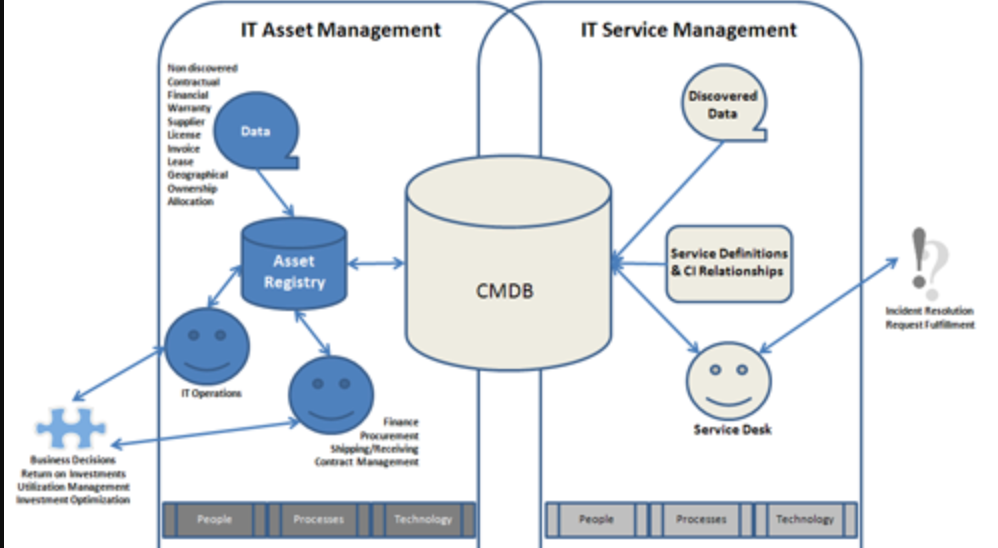
In simple terms: ITAM knows what you have; ITSM governs how you use it.
Where ITAM and ITSM Overlap
Despite their different perspectives, there are critical overlap areas:
- Configuration Management (CMDB) – a shared backbone that maps assets to configuration items (CIs) and services.
- Change and release – ITAM needs to know when assets are deployed, repurposed, or retired; ITSM controls the change process.
- Incident and problem management – resolving a ticket is faster when the agent sees the asset’s history, ownership, and configuration.
- Software compliance in workflows – approvals for new software often rely on ITAM data about license availability and risk.
- Onboarding and offboarding – combining service requests with automated asset assignment and reclamation.
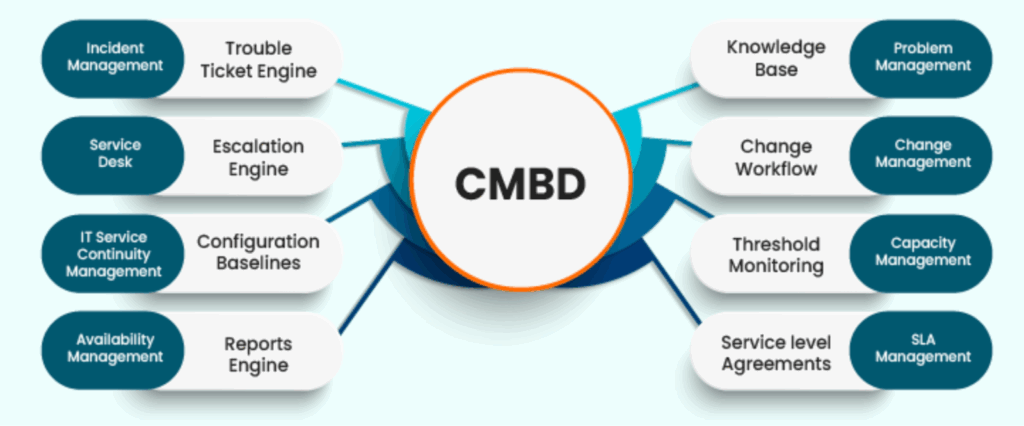
When ITAM and ITSM share data and processes, the organization gets a consistent view of technology risk, cost, and performance. To evaluate options that enhance CMDB accuracy, automated discovery, and change governance, practitioners can consult this comparative review of leading configuration management tools used across ITAM–ITSM programs.
Why Integrated ITAM + ITSM Delivers the Highest Business Value
1. Operational Efficiency
Integrated ITAM–ITSM reduces duplication:
- Service desk agents no longer chase spreadsheets to understand which device belongs to whom.
- Asset updates can be triggered automatically by service requests and change records.
- Decommissioning a service can automatically trigger asset retirement workflows and license reclamation.
2. Security & Compliance
Security teams benefit from a shared asset–service view:
- Faster incident triage – from an alert on an endpoint, analysts can rapidly see services, owners, and business criticality.
- Better vulnerability management – asset and service context helps prioritise patching where it matters most.
- Regulatory readiness – auditors expect evidence that the organisation controls both its assets and the services built on them.
3. Cost Optimisation
Integrated data supports:
- Identification of underused licenses and hardware tied to low-value or redundant services.
- Smarter renewal decisions based on real consumption and service importance.
- Joint planning between IT, security, and finance around refresh cycles and cloud consumption.
4. Better Decision-Making
Executives gain a more complete picture:
- Which services rely on legacy or unsupported assets?
- Where are high-risk assets supporting critical services without appropriate controls?
- Which service portfolios deliver the most value relative to their asset and licensing cost?
Key Challenges When ITAM and ITSM Operate Separately
Many organisations still run ITAM and ITSM as independent initiatives. Typical pain points include:
- Data silos – service desk tools and asset databases contain overlapping but inconsistent information.
- Inaccurate CMDB – CIs are created once and never updated, leading to low trust in configuration data.
- Shadow IT and blind spots – security and operations teams discover devices or SaaS subscriptions only during incidents.
- Manual, error-prone processes – onboarding, offboarding, and refreshes rely on emails and spreadsheets.
- Compliance gaps – licenses are over-deployed or under-used because ITAM has no visibility into live service usage.
These challenges are not purely technical; they reflect missing governance and a lack of shared ownership between ITAM, ITSM, security, and finance.
Best Practices for Building a Unified ITAM–ITSM Framework
1. Establish a Single Source of Truth
Create a shared data model where:
- CMDB and asset repository are tightly aligned, ideally within one platform or tightly integrated tools.
- Assets are linked to services, owners, locations, and business functions.
2. Automate Discovery
Use automated discovery and inventory to continuously populate asset and configuration data:
- Network and endpoint discovery
- Cloud and SaaS discovery
- Integration with identity providers (for ownership)
This keeps both ITAM and ITSM data fresh and trustworthy.
3. Map Assets to Services and Risk
For every key service, define:
- The supporting assets and configurations
- Data sensitivity and regulatory scope
- Business impact of downtime
This mapping becomes invaluable for security assessments, business continuity, and change impact analysis.
4. Align Processes with Established Standards
Use established frameworks as guardrails rather than rigid rules:
- ITIL 4 for service management practices (incident, change, problem, request, service catalogue).
- ISO/IEC 19770-1 for structuring ITAM as a management system with clear policies, roles, and continual improvement.
5. Create Shared Governance
Define a joint steering group or governance forum that includes:
- IT operations / service management
- ITAM / finance and procurement
- Cybersecurity / risk
- Business stakeholders
Their mandate: prioritise integrated initiatives, approve policies, and resolve conflicts between cost, risk, and service quality.
6. Integrate Incident, Change, and Asset Lifecycle
Design workflows so that:
- New hardware or software requests automatically create or update asset records.
- Changes that affect configurations update both CMDB and asset repositories.
- Decommissioning a service triggers retirement or repurposing of related assets and licenses.
7. Make Reporting Cross-Functional
Move away from siloed reports (e.g. “ITAM report”, “ITSM report”) and instead provide:
- Joint risk and compliance dashboards – linking assets, services, and controls.
- Cost vs value views – combining license/asset spend with service SLAs and usage.
- Executive summaries that speak to business outcomes, not just technical metrics.
How Modern Platforms Support ITAM–ITSM Convergence
The growing complexity of IT environments makes manual integration unsustainable. Modern platforms increasingly combine ITAM, ITSM, and sometimes discovery and configuration management in a single solution.
Solutions in this space, including Alloy Software and InvGate Service Management exemplify this convergence by:
- Providing a unified CMDB and asset repository with automated discovery.
- Linking incidents, requests, changes, and problems directly to specific assets and services.
- Supporting full lifecycle management – from procurement and deployment to retirement and disposal.
- Offering role-based dashboards for operations, security, and finance, all based on the same underlying data.
For organisations just starting this journey, a platform that natively supports both ITAM and ITSM can significantly reduce integration overheads and accelerate maturity. For those with existing tools, Alloy-style architectures show the design principles to aim for: shared data, consistent workflows, and strong analytics.
Future Trends: Where ITAM and ITSM Are Heading
Looking ahead, several trends are reshaping how ITAM and ITSM will operate:
- AI-driven discovery and correlation – machine learning to detect unknown assets, group them into services, and highlight anomalies.
- Predictive analytics – forecasting asset failures, capacity issues, and licence shortfalls before they impact services.
- Deeper integration with cybersecurity (CAASM) – cyber-asset attack surface management tools increasingly rely on ITAM and ITSM data to identify exposures.
- FinOps + ITAM + ITSM triangulation – cloud cost management disciplines depend on accurate asset data and service usage metrics.
- Greater focus on user experience – end-users expect consumer-grade portals where service requests, assets, and approvals are all visible in one place.
These trends reinforce the same message: asset and service data need to live together and be continuously enriched, not managed as separate spreadsheets or disconnected modules.
“ITAM vs ITSM” Is the Wrong Question
In an earlier era, organisations could treat ITAM as a back-office inventory function and ITSM as a front-line support discipline. Today, that separation undermines security, governance, and financial control.
- ITAM provides hard facts about what exists – assets, contracts, licenses, and their lifecycle states.
- ITSM provides structured processes for how technology is used – services, tickets, changes, and SLAs.
The real value emerges when these views converge into a single, trusted, and continuously updated model of the IT environment. Platforms such as Alloy Software, coupled with frameworks like ITIL 4 and ISO/IEC 19770-1, give organisations the tools and guidance to make that convergence real – not just conceptually attractive.
For digital-first enterprises and security-conscious sectors alike, the strategic move is clear: stop asking whether ITAM or ITSM “matters more”, and start designing an operating model in which assets, services, risk, and value are managed together.