
Top App Ideas for Digital Nomads
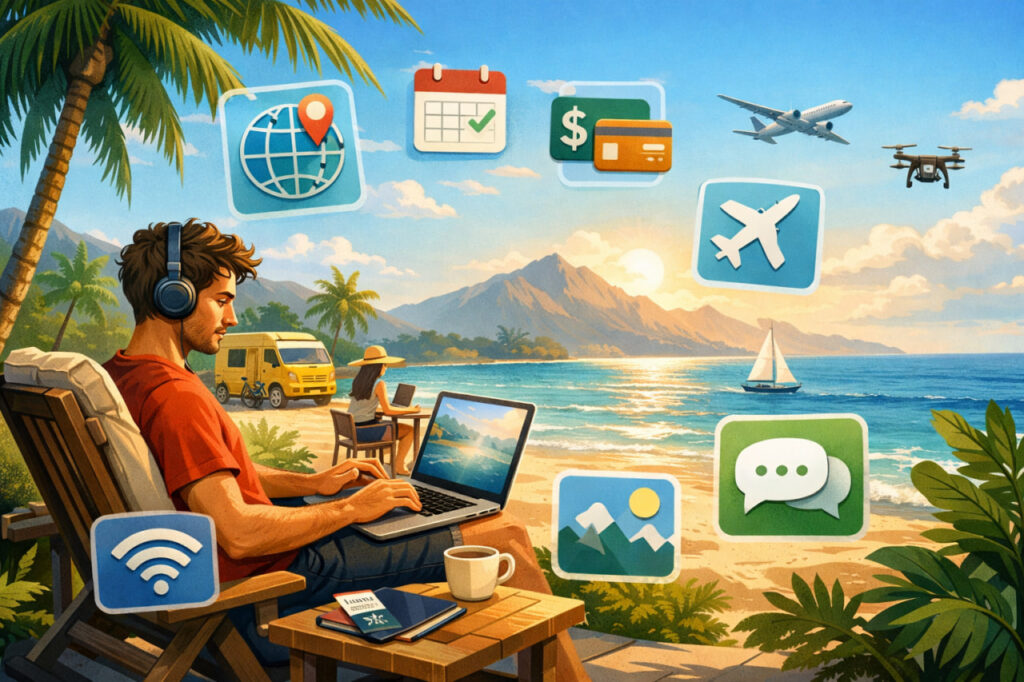
The digital nomad community has grown from a niche group to a widespread demographic with disposable income and issues that need to be addressed. In the United States, the number of people who identify as digital nomads is expected to reach 18.5 million by 2025. This is an increase of 2.2% compared to the previous year. This growth, which has been 153% since 2019, indicates that the trend of working remotely is here to stay and that the supporting technology infrastructure is still evolving.
Digital nomads are an important audience for app developers because they are heavy mobile device and app users. They rely on apps for communication, connectivity, productivity, safety, travel planning, and payments. However, poor app performance may lead to rapid user churn, motivating engineers to improve the user experience and increase retention.
This article will explore who digital nomads are, what they need, and which app categories have the greatest potential for success. It will also discuss strategies for responsibly monetizing apps.
Who Digital Nomads Are and What They Need
Digital nomads are remote professionals, freelancers, entrepreneurs, employees, and creators – who live and work while traveling. They are defined not by their nationality but by their behavior: regular relocations, reliance on mobile networks, and the constant need to keep productivity in several time zones.
Their main challenges can be grouped into five categories:
- Problems with connection, like SIM/eSIM not working, bad Wi-Fi, need for a private network (VPN), and security of data.
- Time management and focus, including deep work, asynchronous collaboration, and scheduling in different time zones.
- Financial management (multi-currency transactions, fees, expense monitoring, and tax compliance)
- Logistical support and convenience (meeting accommodation standards, access to coworking facilities, and guaranteeing neighborhood safety).
- Assistance with social and mental well-being, including addressing feelings of loneliness, discovering events and activities, accessing healthcare services, and preserving daily habits.
Why are Digital Nomads valuable customers? They are typically users who frequently engage with your app and do so with strong intent. When your app makes their daily life easier, it becomes a habit. Because many nomads are influential in their social circles, such as Slack groups, Telegram chats, and Reddit communities, word of mouth can spread quickly, especially when your product is the one that truly works while traveling.
Top App Opportunities for Digital Nomads
1) Productivity & collaboration tools
Nomads thrive on systems. Build apps that reduce mental effort and make remote work feel “stable” even when life isn’t.
Specific app ideas:
- Timezone-smart planner that auto-suggests overlap windows, meeting buffers, and “quiet hours” based on travel.
- Offline-first notes + tasks that sync smoothly after spotty connections (conflict resolution done right).
- An async team update tool that turns standard check-ins into quick voice notes, auto-transcribed and summarized.
Retention hook: streaks for routines, “weekly review” templates, and shareable status exports.
If you want a fast path to prototyping without upfront heavy engineering, you can package early versions and test demand quickly (for example, using a lightweight builder approach and iterating based on user feedback). A helpful starting point is AppsGeyser’s guide on building with AI workflows and rapid iteration: https://appsgeyser.com/blog/ai-app-builder/
2) Finance & expense tracking apps
Nomads spend across currencies, platforms, and jurisdictions. The pain is rarely budgeting – it’s clarity, fees, and proof.
Specific app ideas:
- Multi-currency expense tracker with automatic currency conversions at the time of purchase.
- Subscription/recurring fee tracker (eSIM plans, VPNs, coworking memberships) with alerts before renewals.
- Receipt-invoice pipeline for freelancers: snap a receipt, categorize, export to client invoice or tax folder.
Monetizable features: premium exports, accounting integrations, automated tax tagging, and travel reporting.
3) Connectivity & travel solutions
Connectivity is oxygen. Most nomads would rather downgrade accommodation than risk unreliable internet. This category is perfect for apps because it blends urgency (need internet now) with ongoing habit.
Specific app ideas:
- Connectivity checklist app: pre-trip reminders (VPN, backup eSIM, hotspot plan, speed test), plus “arrival mode” actions.
- A Wi-Fi health monitoring tool that records speed and stability, suggests optimal working hours, and alerts about risky networks.
- A roaming cost calculator that compares options based on destination and usage patterns.
A natural partnership play here is eSIM providers and travel connectivity services. For example, if you’re curating reliable data options for Japan trips, you can reference Mobal unlimited data eSIM as an easy solution for high-usage travelers who don’t want to think about top-ups.
4) Accommodation & workspace finders
Digital nomads don’t just need a bed – they need a workable base. Traditional filters (price, rating) aren’t enough.
Specific app ideas:
- Workability score for stays: desk quality, chair ergonomics, noise, internet speed history, and power outlet density.
- Coworking “fit” matcher: quiet vs. social, phone-booth availability, day-pass pricing, community events.
- Neighborhood sanity checks: walkability, safety reports, proximity to groceries, gym access, late-night noise.
Differentiator: community-sourced nomad-specific attributes with verification (speed tests, photo proof).
Revenue Models for Digital Nomad Apps
Subscription Model: Best Use Cases
Ideal when you provide ongoing value: recurring insights, premium filters, automated tracking, cloud sync, or advanced exports. Keep tiers simple (Monthly/Annual) and make it all obvious in the first session – nomads won’t wait.
Freemium: Let users feel the value
Use free to capture habits, then gate features: offline mode, advanced analytics, team sharing, unlimited destinations, or integrations (Notion/Slack/accounting tools). Freemium works best when the free version still solves a real pain – otherwise, users churn before they understand the upgrade.
Partnerships & Affiliate Revenue
Nomad apps are designed to be partnership-friendly, often including eSIM providers, virtual private networks (VPNs), travel insurance, coworking and coliving spaces, and luggage brands.
These joint ventures are integrated ethically through the following key practices:
- Only recommending relevant offers based on the user’s destination and behavior.
- Clearly comparing different options for the user.
- Transparently labeling affiliate links.
If you’re also considering distribution, ASO (App Store Optimization) matters. AppsGeyser’s guide to launching and publishing apps can help you understand the basics of going to market: https://appsgeyser.com/blog/app-publication-on-google-play/.
Your First Steps: Research, MVP, Feedback
To validate a digital nomad app concept quickly:
- Select one urgent issue (connectivity backup, time zone confusion, or multi-currency understanding). Do not bundle everything.
- Assess demand with a landing page, a waiting list, and a brief “use case survey” (where they travel, how they operate, and their greatest challenge).
- Create a Minimum Viable Product (MVP) that performs one task perfectly: one page, one process, one clear result. An offline-first approach represents a significant advantage in this market.
- Monitor early retention (day-1 worth, week-1 habit, month-1 upgrades).
Where to recruit testers:
- Coworking spaces
- Nomad Telegram groups
- Reddit communities
- Facebook groups
- Local meetups in major cities (Lisbon, Bali, Chiang Mai, and Mexico City)
You can offer testers a discount in exchange for regular feedback calls and recording usage data.
Conclusion
Digital nomads are a growing and high-frequency group of users who face real challenges. They appreciate products that function reliably in challenging conditions. As millions of remote workers embrace flexible work arrangements, there is an opportunity to provide productivity, financial management, connectivity, and “liveable” solutions.
If you are planning to develop your next application, it is recommended that you focus on one key aspect of nomadic life: the nomadic workflow. It is advisable to release a minimum viable product (MVP) and test it among communities of nomads who regularly share tools and resources. The best solutions in this field not only assist nomads in their travels but also help them maintain work (and lifestyle) stability wherever they find themselves.