How Crypto Payment APIs Work: Unique Addresses, Transaction Tracking, and Non-Custodial Payments
Accepting crypto payments is not just about showing a wallet address at checkout. A business also needs to connect each incoming payment to a specific order, track the transaction automatically, and confirm when the payment is complete.
That is why businesses that want to accept crypto usually rely on payment infrastructure that can generate a unique address for each transaction, monitor blockchain activity, and send callbacks or webhooks when the payment reaches the required status.
This becomes especially valuable in a non-custodial model. In that setup, funds go directly to the merchant wallet, the provider does not hold balances, and private keys stay outside the provider’s control.
In this article, we will explain how crypto payment APIs work behind the scenes, why unique addresses matter, how payment tracking is handled programmatically, and what non-custodial processing means in practice.
What a crypto payment API actually does
A crypto payment API is the technical layer that connects a merchant’s checkout system with blockchain payment flows. Its job is not only to create a payment destination, but also to structure the entire payment lifecycle in a way that software can process automatically.
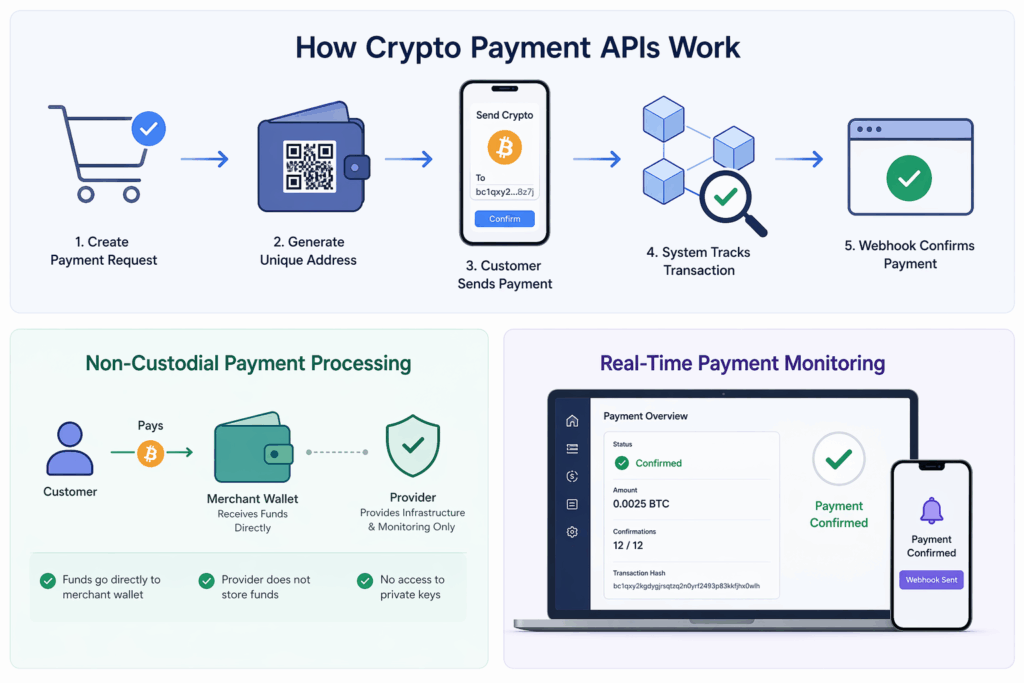
In a typical integration, the API helps the merchant’s system do five things:
- Create a payment request for a specific order
- Generate a unique wallet address for that payment
- Detect when a customer sends funds
- Track blockchain confirmations
- Trigger a callback or webhook when the payment is confirmed
Without this type of automation, a business would have to monitor incoming payments manually, compare wallet activity with internal orders, and decide when a payment should be treated as complete. That process becomes difficult and error-prone as soon as payment volume grows.
For companies building apps, marketplaces, paid content products, or subscription services, automated crypto payment flows are especially useful because they reduce operational work and make blockchain payments easier to integrate into digital products. You can also see how crypto fits into mobile product monetization in this AppsGeyser article: How to Marry Crypto with Mobile App Monetization.
Why payment systems generate a unique address for every transaction
One of the core mechanics of a crypto payment API is generating a new address for each payment request.
At first glance, it may seem easier to use one wallet address for all payments. But in practice, address reuse creates problems. If ten customers all send the same asset to the same wallet, the merchant then has to determine which payment belongs to which order. That becomes even harder when customers send the wrong amount, pay late, or initiate transactions around the same time.
A unique address per transaction solves this problem. Each order receives its own payment destination, so the system can match incoming blockchain activity directly to the correct invoice or checkout session.
This model provides several practical benefits:
Clear order-to-payment matching
When every order has its own address, incoming funds are easier to reconcile. The system does not have to guess which payment belongs to which purchase.
Better operational automation
A dedicated address makes it easier to automate invoice creation, blockchain monitoring, status updates, and final confirmation.
Improved privacy
Reusing the same public address repeatedly makes payment activity easier to trace. Generating a fresh address for each transaction reduces address reuse and gives customers and merchants better privacy.
Easier handling of payment exceptions
If a customer underpays, overpays, or pays after an invoice expires, the system can evaluate that event within the context of a specific payment request instead of a shared wallet stream.
Basic payment flow: from invoice creation to confirmed transaction
To understand how crypto payment APIs work, it helps to look at the full flow step by step.
1. The merchant system generates a payment request
The process begins when a customer reaches checkout and chooses to pay with crypto.
At that point, the merchant backend creates a payment request. This request usually includes information such as:
- order ID
- amount due
- selected cryptocurrency
- blockchain network
- expiration time
- metadata for internal records
The payment API receives this request and prepares a payment session tied to that specific order.
2. The API creates a unique payment address
After the payment request is created, the system generates a unique address dedicated to that transaction.
This is the address shown to the user on the payment screen, often together with the exact amount, supported network, and a QR code for convenience. At this stage, the address is already linked in the system to a specific payment record.
The customer does not need to understand any of the backend logic. From their perspective, they simply see a destination wallet address and send funds to it.
3. The customer sends the payment
The user opens a crypto wallet, copies the address or scans the QR code, and submits the transfer.
Once broadcast, the transaction enters the blockchain network. Depending on the network and the wallet used, the payment may appear first as pending or unconfirmed before it reaches the required number of confirmations.
This is where automation becomes important. The merchant should not need to open a block explorer and manually check whether the payment has arrived.
4. The system tracks the transaction programmatically
After the address has been assigned, the payment infrastructure begins monitoring it.
The system can track:
- whether a transaction has been detected for that address
- which asset was sent
- how much was received
- the transaction hash
- current confirmation count
- whether the invoice is paid, partially paid, overpaid, expired, or still pending
This part of the process is what turns a static wallet address into a real payment workflow. The API is not just generating an address. It is also linking blockchain activity to business logic.
5. The API sends a callback or webhook
When the payment reaches the required state, the system sends a callback or webhook to the merchant’s backend.
That webhook may tell the merchant application that:
- payment has been detected
- payment is awaiting confirmations
- payment is confirmed
- payment expired
- payment amount is insufficient
Once the merchant system receives the confirmation event, it can automatically update the order status, unlock content, approve access, or trigger fulfillment.
This is the step that closes the loop between blockchain infrastructure and the merchant’s own app, website, or platform.
How unique address generation works behind the scenes
To the user, a generated address looks simple. But under the hood, there is usually a structured workflow.
A payment API does not randomly create addresses without context. Instead, it associates each newly generated address with a payment object inside the merchant’s system. That object usually includes the invoice ID, expected amount, selected currency, expiration window, and status.
The logic often looks like this:
- create invoice or payment request
- assign new address
- store address in database with order reference
- begin monitoring blockchain activity for that address
- detect matching transaction
- update status based on confirmations
Because the address is tied to a specific payment request from the start, the system can programmatically manage the full lifecycle.
In practical terms, this means that payment APIs are really managing two parallel layers at once: the blockchain layer, where transactions occur, and the application layer, where invoices, orders, and customer actions are stored.
How payment tracking works programmatically
Tracking a blockchain payment is not only about seeing whether funds arrived. A robust payment system usually checks several variables before marking an invoice as paid.
Address monitoring
The most direct signal is activity on the unique address assigned to the invoice. If a transaction appears on that address, the system can associate it with the correct payment request immediately.
Amount validation
The API compares the received amount with the expected amount. This matters because customers may sometimes send too little, too much, or the correct amount after price movement or manual entry mistakes.
Asset and network validation
A payment request must also match the expected cryptocurrency and blockchain network. A merchant may support USDT on one network but not another, or support BTC but not ETH. The system should validate that the transfer arrived in the intended format.
Confirmation tracking
A transaction detected on-chain is not always treated as final immediately. Many payment systems wait for a predefined number of confirmations before marking the payment as complete. This helps reduce the risk of temporary chain states or premature fulfillment.
Status management
Most crypto payment APIs work with status transitions rather than a simple yes-or-no model. A payment may move through stages such as:
- created
- pending
- detected
- confirming
- confirmed
- expired
- underpaid
- overpaid
This status model is important because merchants often need different actions at different stages. For example, a digital product may only be delivered after final confirmation, while a dashboard might already show that payment has been detected.
What a webhook usually confirms
A webhook is the bridge between blockchain events and merchant automation.
When the payment API detects a relevant status change, it sends an HTTP request to a predefined endpoint on the merchant’s server. This lets the business react automatically instead of checking transaction status manually.
A typical webhook payload may include:
- invoice or payment ID
- order ID
- wallet address used for the payment
- transaction hash
- asset and network
- amount expected
- amount received
- current status
- number of confirmations
- timestamp
The merchant’s backend then uses that information to update internal records and trigger the next business action.
For example, a mobile app could unlock premium access, a SaaS platform could activate a subscription, or an eCommerce site could mark an order as paid and start fulfillment.
Non-Custodial Payment Processing: what it means
Non-custodial payment processing is one of the most important concepts in crypto infrastructure, but it is often explained too vaguely.
In simple terms, non-custodial means the payment provider helps the merchant process and monitor payments without taking control of the merchant’s funds.
Funds go directly to the merchant wallet
In a non-custodial setup, the payment destination is tied to the merchant’s own wallet infrastructure. When the customer sends funds, those assets are routed directly to an address associated with the merchant, not parked in a provider-controlled balance.
The provider does not store merchant funds
A non-custodial provider is not acting like a bank or exchange wallet that holds settlement balances on behalf of the merchant. Its role is to facilitate address generation, payment detection, and event handling.
The provider does not have access to private keys
This is one of the most important security distinctions. The provider may work with public wallet data or infrastructure that allows it to generate payment addresses and monitor incoming funds, but it does not need control over the merchant’s private keys.
That means the merchant keeps custody, while still benefiting from automated infrastructure.
Why merchants prefer non-custodial infrastructure
For many businesses, non-custodial processing offers a better balance of automation and control.
First, it reduces counterparty risk. If a provider is not holding your funds, your exposure is lower than in a model where settlement depends on a third party storing assets on your behalf.
Second, it aligns better with the original promise of crypto: direct ownership and direct receipt of funds.
Third, it can simplify internal treasury logic. Instead of waiting for funds to be released from a custodial account, businesses can receive payments directly into their own wallet flow.
This model can be especially relevant for digital businesses, app projects, and global products that want to combine automation with flexible monetization.
Common implementation challenges
A good article on crypto payment APIs should also acknowledge that real payment flows are not always clean.
Underpayments and overpayments
Customers do not always send the exact amount requested. The system needs rules for handling partial payments, excess amounts, or invoice mismatches.
Expired payment requests
Many invoices are only valid for a limited time. If a user pays late, the backend needs a clear way to decide whether to accept, reject, or manually review the transaction.
Confirmation delays
Different blockchains settle at different speeds. Businesses need to decide whether to act on detection, on one confirmation, or on a higher confirmation threshold.
Network mistakes
A user may send funds using the wrong network or unsupported token standard. Payment APIs should help reduce this risk by clearly defining the required asset and chain in the payment request.
Duplicate events or retry logic
Webhook systems should be designed to handle repeated notifications safely. Merchant backends need idempotent logic so the same event does not create duplicate fulfillment actions.
Custodial vs non-custodial crypto payment processing
Although both models can automate payment acceptance, the operational logic is different.
In a custodial setup, the provider usually receives and stores funds first, then settles them to the merchant later. In that model, the provider is part of the custody chain.
In a non-custodial model, the provider helps orchestrate the payment process, but the assets move directly into the merchant’s wallet flow. The provider supports address generation, tracking, and notifications without controlling the funds themselves.
For merchants that care about wallet ownership, reduced third-party control, and direct settlement, non-custodial infrastructure is often the stronger option.
Final thoughts
Crypto payment APIs do much more than generate a wallet address. They create structured payment requests, assign unique addresses to each transaction, monitor blockchain activity, validate incoming payments, and notify merchant systems when payment conditions are met.
Generating a unique address for every transaction is one of the key mechanics that makes automated reconciliation possible. It lets businesses connect each blockchain payment to a specific order, reduce ambiguity, and scale payment processing more efficiently.
When this architecture is combined with a non-custodial model, the result is even more attractive. Funds go directly to the merchant wallet, the provider does not store balances, and private keys remain outside the provider’s control.
For businesses that want to accept crypto without relying on manual wallet checks or custodial holding models, that is the real value of a modern crypto payment API.
FAQ
Why do crypto payment APIs generate a unique address for each transaction?
A unique address helps the system link one payment to one order. This makes reconciliation easier, improves automation, and reduces the problems caused by address reuse.
How does a crypto payment API track payments?
The system monitors the blockchain for activity on the assigned payment address, checks the asset and amount, tracks confirmations, and updates the payment status accordingly.
What does non-custodial payment processing mean?
It means the provider helps generate addresses, monitor transactions, and send payment events without holding merchant funds or controlling private keys.
Do funds go to the payment provider first in a non-custodial model?
No. In a non-custodial setup, funds go directly to the merchant wallet infrastructure rather than being stored by the provider.
Why are webhooks important in crypto payment processing?
Webhooks let the payment system notify the merchant backend automatically when a payment is detected, confirmed, expired, or requires review.