Top 10 Image Generation APIs Model Showdown 2026: Which Platform Wins on Frontier Model Coverage?
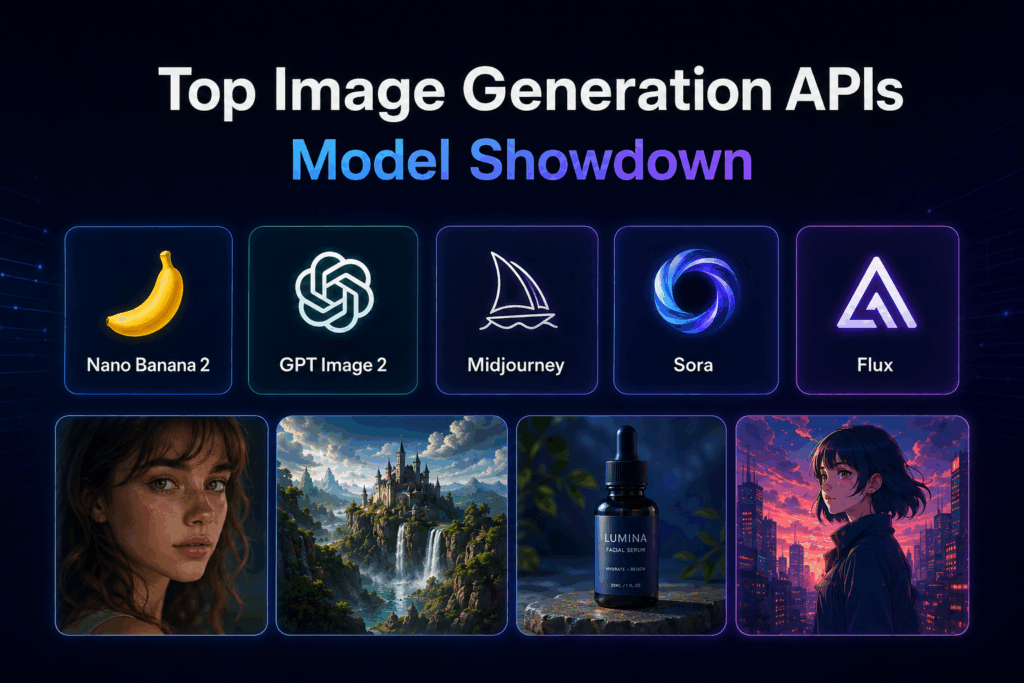
By 2026, “which model is best” stopped being a useful question. The real question is which platform actually gives you access to the model you need today, without forcing you to spin up a new account every time a new release lands. Nano Banana 2, GPT Image 2, Midjourney, Sora, Kling, Veo — the list keeps growing, and the platforms that haven’t kept pace are starting to feel narrow.
This guide ranks 10 image generation platforms with one specific lens: model coverage breadth. How many frontier models can you actually call from a single credential? How quickly does new model support land after release? Pricing is in the mix for context, but model breadth is what we’re measuring.
TL;DR — Quick Comparison Table
| Platform | Pricing Model | Nano Banana 2 (1K) | GPT Image 2 (1K) | Model Coverage Highlight |
| ApiPass | Pay-per-use credits | $0.014 | $0.005 | Both flagships under one credit pool, fast on new releases |
| artlist.io | Subscription tiers | ~$0.012 (Starter) | ~$0.012 (Starter) | 100+ models across image, video, audio |
| imagine.art | Subscription + credits | ~$0.303 (Basic) | ~$0.477 (Basic) | Image + video + GPT/Gemini/Claude LLMs |
| mujoai | Subscription tiers | ~$0.043 (2K, Basic) | ~$0.129 (Basic) | Nano Banana 2, Pro, Midjourney, GPT Image 2 |
| everypixel | Subscription + credits | ~$0.012 (Starter) | ~$0.012 (Starter) | 100+ models in one credit pool |
| eachlabs.ai | Pay-per-run | $0.08 | $0.053 | Current + legacy model versions side by side |
| kyncept | 1 image = 1 credit | ❌ Not supported | ~$0.0475 (Starter) | GPT Image 2 only — narrowest coverage |
| getimg.ai | Subscription + credits | ~$0.024 (Plus) | ~$0.038 (Plus) | Multi-resolution Nano + GPT under one pool |
| runware.ai | Pay-per-request | $0.069 | $0.006 (Low) | Quality-tier variants of frontier models |
| fuser.studio | Subscription + ✦ credits | $0.083–$0.204 | $0.006–$0.496 | Complexity-priced model access |
10 Best API Platforms for Image Generation Performance: A Detailed Breakdown
ApiPass
Model Coverage Breadth
ApiPass takes a focused-but-deep approach to model coverage. Rather than listing hundreds of models for the sake of a long landing page, it concentrates on the frontier image models that real teams actually deploy — Nano Banana 2 across 1K, 2K, and 4K, plus GPT Image 2 across low, medium, and high quality. Both flagships sit under one credit pool and one credential, so switching between Google’s and OpenAI’s flagship models is a parameter change, not a re-integration. New model releases tend to land on ApiPass quickly too, which matters when a frontier model drops mid-quarter and you don’t want to wait three weeks for support. You can hit the GPT Image 2 API through the same setup that handles everything else.
Features
Nano Banana 2 in 1K, 2K, and 4K. GPT Image 2 in low, medium, and high quality. Three pricing tiers (Starter, Regular, Official) that let you trade cost for queue priority without rewriting code. One credit pool covers everything.
Pros & Cons
Pros: Both Google and OpenAI flagships behind one credential. Fast support for new model releases. 70–80% cheaper than the official APIs. No subscription required.
Cons: Catalog is narrower than the everything-and-the-kitchen-sink platforms — if you need niche models, that breadth lives elsewhere. Some enterprise polish (SSO, audit logs) still rolling out.
Pricing (per image)
- Nano Banana 2 (1K): $0.014 (Google direct: $0.070)
- Nano Banana 2 (2K): $0.023 (direct: $0.105)
- Nano Banana 2 (4K): $0.032 (direct: $0.140)
- GPT Image 2 (1K low): $0.005 (direct: $0.015)
Best For
Teams that want unified access to the current frontier image models without the official-API price tag, and fast adoption of new flagships as they ship.
artlist.io
Model Coverage Breadth
artlist.io has one of the widest catalogs in this guide if you count beyond image generation — over 100 models spanning image, video, voice, and music. For builders working across modalities, that’s a real strength. The trade-off is that image-specific depth isn’t as tuned as on platforms focused purely on image work. ApiPass’s narrower catalog goes deeper on the frontier image models specifically, which matters more if image is your core workload.
Features
A full AI Suite covering image (Nano Banana 2 + Pro), video (Sora, Kling 3.0, Veo 3.1), voice, and music. Higher tiers lift caps on selected models. Annual billing knocks 40% off.
Pros & Cons
Pros: 100+ models across modalities. One credential for image, video, audio, and music. Unlimited generation at Professional tier.
Cons: Higher entry price than image-only platforms. Paying for capacity you may not use if your product is image-only.
Pricing (per image, ~10 credits per image)
- AI Starter ($19.99/mo, 16,500 credits): ~$0.012/image
- AI Creator ($69.99/mo, 80,000 credits): ~$0.009/image
- AI Professional ($399.99/mo, 500,000 credits): ~$0.008/image
- Custom Business: unlimited across all models
Best For
Teams building multi-modal creative products who want one vendor across image, video, and audio.
imagine.art
Model Coverage Breadth
imagine.art’s coverage stretches across modalities and into LLMs — image generation, video generation, plus GPT, Gemini, and Claude on the language side. That all-in-one positioning is genuinely unique. The catch for image-specific workloads: per-image pricing is high, and most of the platform’s value comes from the bundle rather than from image generation in isolation. ApiPass keeps image generation as the centerpiece, with frontier model coverage that’s deeper on a per-image basis.
Features
Image generation plus video plus GPT, Gemini, and Claude on the LLM side. Higher tiers unlock private generation, priority queue, and team collaboration up to 20 people. Parallel generation supports 16 image jobs and 5 video jobs at once on Creator tier.
Pros & Cons
Pros: Image, video, and LLMs in one subscription. Strong team collaboration. Private mode on higher tiers.
Cons: Lower tiers throttle parallel jobs. Basic plan makes generations public by default. Per-image cost is high compared to focused API platforms.
Pricing (Basic plan: $13/mo, 3,000 credits)
- Nano Banana 2 (1K / 2K / 4K): $0.303 / $0.477 / $0.715
- GPT Image 2 (1K / 2K): $0.477 / $1.083
Best For
Creative teams that want image, video, and LLMs in one bundle, and don’t mind paying a premium per image.
mujoai
Model Coverage Breadth
mujoai’s coverage is narrower than the multi-modal platforms but covers an interesting mix for image specifically — Nano Banana 2 (2K), Nano Banana 2 Pro (4K), Midjourney, and GPT Image 2 Low. The inclusion of Midjourney is the standout, since Midjourney access is rarer at this price point. The trade-off is that quotas are split per model rather than pooled, so unused capacity in one model can’t subsidize another. ApiPass pools credits across models, which gives more flexibility once your usage patterns shift.
Features
Four-tier subscription. Each plan lists image counts per model. Nano Banana 2 always gets twice the quota of Pro at the same tier. Midjourney bundled at every tier.
Pros & Cons
Pros: Cheap entry at $9/mo. Midjourney included alongside Nano Banana 2 and GPT Image 2. Per-model quotas are transparent.
Cons: Quotas don’t roll over month to month. GPT Image 2 quota is the smallest of the bunch. Quotas are siloed per model.
Pricing (per image)
| Plan | Monthly | Nano 2 (2K) | Pro (4K) | GPT Image 2 Low |
| Start | $9 | ~$0.050 (180) | ~$0.100 (90) | ~$0.150 (60) |
| Basic | $19 | ~$0.043 (440) | ~$0.086 (220) | ~$0.129 (147) |
| Pro | $34 | ~$0.039 (880) | ~$0.077 (440) | ~$0.115 (295) |
| Creator | $84 | ~$0.035 (2,380) | ~$0.071 (1,190) | ~$0.106 (793) |
Best For
Hobbyists and indie creators who specifically want Midjourney alongside the Nano Banana and GPT Image flagships.
everypixel
Model Coverage Breadth
everypixel is one of the widest pure-image catalogs in this list — 100+ models in a single credit pool. For exploration, that breadth is genuinely useful. The flip side is that no individual model gets first-class treatment, and adoption of brand-new frontier releases sometimes lags compared to focused platforms. ApiPass’s narrower model focus tends to mean newer releases land sooner, with deeper resolution and quality coverage per model.
Features
One subscription, one credit pool, dozens of models. Useful for benchmarking the same prompt across providers, or for routing products that switch between models depending on the job. Enterprise allocations scale up to 500,000 credits per month.
Pros & Cons
Pros: Huge model library behind one credential. Single credit pool. Enterprise allocations scale far.
Cons: No pay-as-you-go option. Credits expire monthly. Endpoints are generic rather than per-model optimized.
Pricing (~10 credits per standard image)
- AI Starter ($19.99/mo, 16,500 credits): ~$0.012/image
- AI Creator ($69.99/mo, 80,000 credits): ~$0.009/image
- AI Professional ($399.99/mo, 500,000 credits): ~$0.008/image
Best For
Teams building model-routing products that need wide model coverage from a single API surface.
eachlabs.ai
Model Coverage Breadth
eachlabs.ai’s coverage is interesting in a specific way: both current and legacy model versions sit side by side. Nano Banana v1 is still callable alongside Nano Banana 2, and GPT Image v1.5 alongside GPT Image 2. For teams running A/B tests across model versions, that’s useful. The catalog itself is narrower than the multi-modal platforms, though, and adding new models seems to take a beat. ApiPass keeps focus on the current frontier, with quicker uptake on new releases.
Features
Pay-per-run, no subscription. Text-to-image and edit endpoints for Nano Banana 2 and GPT Image 2. Legacy models (Nano Banana v1, GPT Image v1.5) still available at older prices.
Pros & Cons
Pros: No monthly commitment. Fixed per-call cost. Legacy versions remain accessible for A/B testing.
Cons: Per-image cost is 5–6x what ApiPass charges. Catalog is narrower than the breadth-focused platforms.
Pricing (per image, 1024)
- Nano Banana 2 (text-to-image / edit): $0.08
- GPT Image 2 (text-to-image / edit): $0.053
- Legacy: nano-banana v1 at $0.04, gpt-image v1.5 at $0.05
Best For
Teams that need both current and legacy versions of frontier models for version testing.
kyncept
Model Coverage Breadth
kyncept is on the narrow end of the breadth spectrum — GPT Image 2 only, no Nano Banana 2, no other frontier models. That’s not necessarily a flaw if GPT Image 2 is all you need, but it does cap how far the platform can grow with you. ApiPass covers both Google’s and OpenAI’s flagship image models from the same account, which keeps options open as your project evolves.
Features
Subscription-based with a free tier (10 credits, 7-day retention). Higher tiers unlock 4K export, priority queue, and uncapped generation on Business. GPT Image 2 only.
Pros & Cons
Pros: Simplest pricing model in this list. Free tier requires no credit card. Business tier removes generation caps.
Cons: No Nano Banana 2 at all. Lower tiers have shorter file retention. Narrow catalog limits long-term flexibility.
Pricing (per image)
- Free ($0): 10 credits total, 7-day retention
- Starter ($19/mo): ~$0.0475 (400 images)
- Pro ($59/mo): ~$0.0491 (1,200 images, 1080p export)
- Business ($149/mo): ~$0.0496 (3,000+ images, 4K, priority queue)
Best For
Teams that only need GPT Image 2 and want the simplest possible pricing model.
getimg.ai
Model Coverage Breadth
getimg.ai’s coverage sits in a comfortable middle ground — multiple frontier models in one workspace, with resolution and quality variants nicely fleshed out. Nano Banana 2 at 1K/2K/4K and GPT Image 2 at 1K/2K is solid coverage for the two big flagships. The platform tends to lag a beat behind the most cutting-edge releases, though, since it’s a subscription product with longer release cycles. ApiPass moves faster on new frontier additions while keeping a similar level of resolution depth.
Features
Credit-based subscription with multiple frontier models in one workspace. Models and resolutions all draw from one credit pool. Mix and match freely.
Pros & Cons
Pros: Mature platform with stable endpoints. Generous monthly credit pool on Plus. Resolution pricing is clear upfront.
Cons: GPT Image 2 burns credits noticeably faster than Nano Banana 2 at the same resolution. Credits typically don’t roll over.
Pricing (per image, Plus plan ~$12/mo for 35,000 credits)
- Nano Banana 2 (1K / 2K / 4K): $0.024 / $0.038 / $0.057
- GPT Image 2 (1K / 2K): $0.038 / $0.086
Best For
Teams that want resolution depth across frontier flagships in a stable subscription product.
runware.ai
Model Coverage Breadth
runware.ai’s coverage shape is unusual — it leans into quality-tier variants of frontier models rather than spreading thin across many models. Four Nano Banana 2 resolutions, three GPT Image 2 quality tiers, plus token-level billing on advanced GPT Image 2 calls. For fine control over a small set of frontier models, that’s strong. For wide model coverage, less so. ApiPass keeps similar resolution and quality depth on Nano Banana 2 and GPT Image 2, with broader future-model coverage on the roadmap.
Features
Pure pay-per-request, no subscription. Resolution and quality pricing is laid out per call. Advanced GPT Image 2 features use token-based billing ($8/M image input, $30/M output).
Pros & Cons
Pros: No monthly fee. Transparent per-call pricing. Deep quality-tier coverage on supported models.
Cons: Mixed per-request and token billing complicates cost modeling. Per-image cost is higher than ApiPass at the same quality.
Pricing (per image)
- Nano Banana 2 (512×512): $0.0466
- Nano Banana 2 (1K / 2K / 4K): $0.069 / $0.103 / $0.153
- GPT Image 2 (Low / Medium / High): $0.006 / $0.053 / $0.211
Best For
Teams that want deep quality-tier control on Nano Banana 2 and GPT Image 2 specifically.
fuser.studio
Model Coverage Breadth
fuser.studio’s breadth is shaped by its variable-credit billing rather than by a long model list. Each frontier model has a wide cost range based on prompt complexity, which means the same model gives you very different experiences depending on what you ask of it. As a coverage strategy, it’s distinctive — but the actual list of supported models is narrower than the breadth-focused platforms. ApiPass covers similar flagship models with flat per-call pricing that’s easier to reason about.
Features
Star credit (✦) system where billing scales with task complexity. Nano Banana 2 ranges 92–227 ✦ per call. GPT Image 2 swings between 6.6 and 551 ✦. Three subscription tiers — Indie, Professional, Teams.
Pros & Cons
Pros: Floor pricing on simple GPT Image 2 calls is genuinely cheap. Teams tier scales well for shared use.
Cons: Variable cost makes downstream pricing tough. GPT Image 2 at the top end approaches $0.50 per image.
Pricing (Indie plan: $22.50/mo for 25,000 ✦)
- Nano Banana 2: $0.083–$0.204 per image
- GPT Image 2: $0.006–$0.496 per image
Best For
Teams with simple-prompt-heavy workloads who want low floor prices on supported frontier models.
Final Thoughts
Model coverage breadth is one of those metrics that can mean very different things depending on what you’re actually building. If you need image plus video plus audio under one credential, the multi-modal platforms like artlist.io and imagine.art are unmatched in raw breadth. If you want to A/B between dozens of image models for a routing product, everypixel’s catalog is hard to beat. If your workload sits squarely on the current frontier — Nano Banana 2 and GPT Image 2 — a focused gateway with fast adoption of new releases will serve you better than a sprawling catalog.
Heading into 2026, three things tend to matter more than the headline model count: how quickly new frontier models get added after release, how deep the resolution and quality coverage goes per model, and whether one credit pool covers everything you need. The platforms quietly hitting all three around the Nano Banana 2 API and similar frontier endpoints are where serious teams are landing this year. A long model list looks impressive on a landing page, but it doesn’t help if the one model you actually want to use is six months behind.
A few questions worth asking before you pick: Does the platform support the specific models your roadmap depends on? When the next frontier releases ships, will you wait days or months for support? And can you call every model you need from a single credential? Get those right and you won’t be re-integrating every time the model landscape shifts — which, in 2026, it’s still doing all the time.