Best AI-Powered Software Development Companies in Europe for Long-Term Partnerships
Seven European firms building AI that has to survive a compliance audit, a model refresh, and three years of roadmap changes.
Choosing an AI development partner in Europe stopped being a purely technical decision in 2026. The regulatory calendar now shapes what you can ship and when, and the partner who builds your system is the partner who has to document it.
This list looks at seven AI-powered software development companies in Europe through that lens: who can take a model from prototype into production, keep it there, and still be around when the paperwork comes due.
What changed in July 2026
The EU AI Act’s original timeline assumed harmonized standards and national supervisory bodies would be ready. They were not. The Digital Omnibus on AI was adopted as Regulation (EU) 2026/1744, published on 24 July 2026 and in force from 27 July, moving several deadlines with fixed calendar dates rather than a conditional pause.
| Date | What applies | What it means for a build |
| 2 August 2026 | Article 50 transparency obligations, already live | Users must be told when they are interacting with an AI system |
| 2 December 2026 | Transparency marking extends to systems already on the market | Legacy generative features need machine-readable marking retrofitted |
| 2 December 2027 | High-risk obligations for standalone Annex III systems | Sixteen extra months, not a reprieve, to build the documentation trail |
| 2 August 2028 | High-risk obligations for AI embedded in regulated products | Device and machinery makers get the longest runway |
→ The deferral did not soften the high-risk regime. It moved the date. A partner who treats conformity documentation as something to assemble in 2027 is a partner who will be assembling it about a system nobody remembers building.
Three things that separate an AI partner from an AI vendor
- Who owns the weights
A fine-tuned model is an asset. Establish in writing whether the trained artefact and the data used to produce it belong to you or sit inside the vendor’s account.
- Who watches for drift
Model performance decays as the world moves. If nobody has a monitoring contract, you will find out from a customer complaint.
- Who signs the documentation
Conformity paperwork requires knowing exactly how the system was trained and evaluated. That knowledge lives in the team that built it, and it leaves when they do.
The seven companies, compared side-by-side
| Company | Based in | AI position | Regulated-sector footing |
| Mind Studios | Europe and the US | Production AI inside full product ownership | ISO 27001 and ISO 9001; deep healthcare, logistics, and manufacturing industry expertise |
| N-iX | Malta | Measured AI engineering before scaling | Finance and manufacturing at Fortune 500 scale |
| Zühlke | Switzerland | Strategy through to bespoke model delivery | MedTech, pharma and finance; conformity work predates the AI Act |
| ELEKS | Estonia | Data science depth from a computational heritage | Energy, insurance and government |
| Binariks | Estonia and Poland | AI built for audit-ready environments | HIPAA, FDA, GxP and PCI DSS as standing constraints |
| Future Processing | Poland | Advisory-led AI with human judgement retained | Insurance, finance and utilities |
| Dreamix | Bulgaria | AI attached to enterprise Java systems | Manufacturing and enterprise software |
Seven AI-powered software development companies in Europe
1. Mind Studios
Mind Studios approaches AI as an engineering problem attached to a business one, starting with a business analysis phase that produces a scope and action plan.
The AI work sits inside the same delivery structure as the rest of the product, so the team that trains a model is the team that keeps it running. That matters most when a system has to stay accurate for years rather than demo well once.
- Key services: custom software development, business analysis, custom AI development and integration, software scaling and modernization, iOS, Android and web development, UI/UX research and prototyping, code refactoring, etc.
- Founded: 2013
- Team: 100+ specialists across offices in Europe and the US
- AI in production: a computer vision quality control system for a grain packaging manufacturer that cut defect rates from 1% to 0.3% and inspects items in 64 milliseconds; an NLP venue discovery assistant for a nightlife platform; AI contract scanning inside a Saudi property management system; adaptive medical intake questionnaires integrated with Epic’s EHR
- Best for: companies moving an AI feature from proof of concept into an operational system they intend to keep
Industry depth sits in logistics and transportation, real estate, media and streaming, healthcare and fitness, and other industries.
The company is ISO 27001 and ISO 9001 certified, rates 4.9 on Clutch, and works on fixed-price, time and materials, or dedicated team models.
Real-world example of Mind Studios’ AI project:
- Tikpack: computer vision on a live packaging line.
A certified grain producer running 50 packages a minute, more than 22,000 per shift, was losing around 220 packages a day to seal failures, film misalignment, and incorrect cutting. Manual inspection could not keep pace, and accuracy degraded as shifts wore on.
Mind Studios co-wrote the government grant application that funded the project, then built an on-premise system with no cloud dependency: a dual-model architecture pairing YOLOv8m for detection with a PyTorch ResNet50 classifier across six defect classes, trained on 3,500+ frames annotated at the facility itself.
- Defect rate fell from 1.0% to 0.3%, a 70% reduction
- Detection accuracy passed 93% precision and recall, against a manual baseline near 85%
- The full capture-to-rejection cycle runs under 64 milliseconds, with false rejects below 0.6%
- The pilot line saves EUR 39,000 annually and paid for itself in under twelve months
- Every classification is logged with image, confidence score, and timestamp in PostgreSQL
That last line matters more than it looks. Audit-ready traceability is exactly what a high-risk conformity file requires, and manual inspection produced none of it.
What clients say:
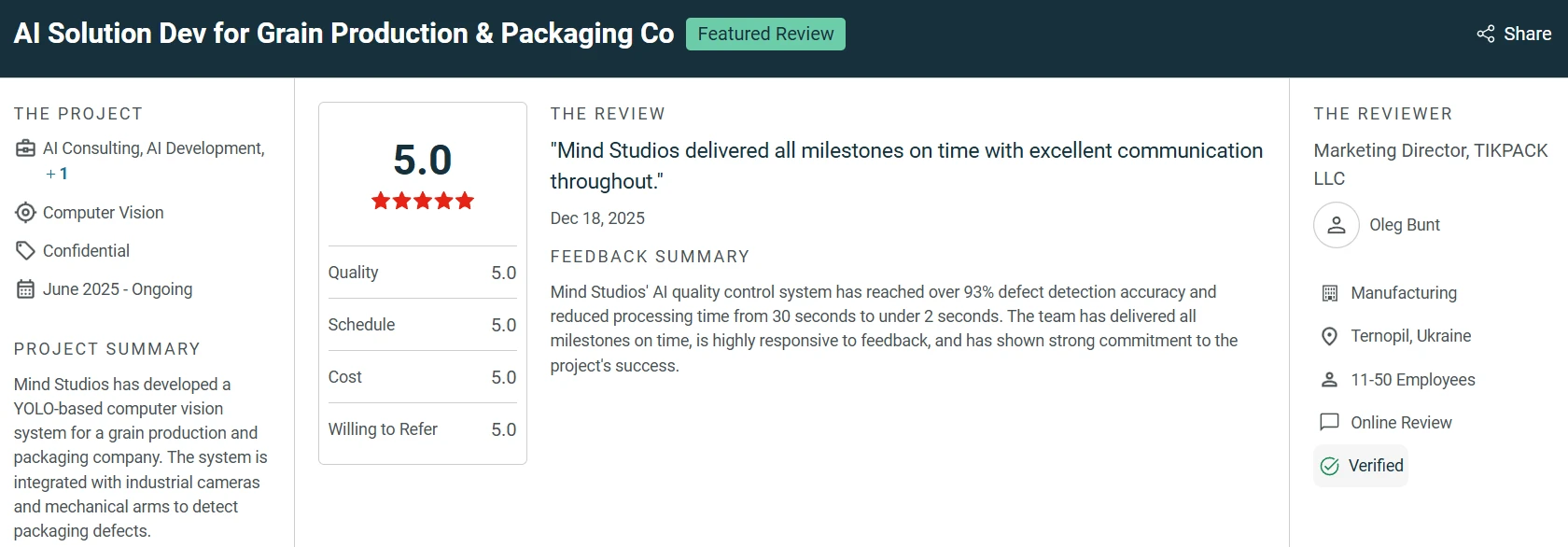
“The team has delivered all milestones on time, is highly responsive to feedback, and has shown strong commitment to the project’s success.”
→ Oleg Bunt, Marketing Director at TIKPACK LLC
2. N-iX
N-iX describes its own position as pragmatic AI engineering, meaning it measures what AI tooling actually delivers on a specific codebase before scaling it. That is an unfashionable stance in a market selling certainty, and it tends to produce fewer abandoned pilots. The firm publishes an average enterprise client relationship of over seven years.
- Key services: software engineering, AI consulting and implementation, data platform engineering, cloud migration and managed services, application modernization, cybersecurity
- Founded: 2002
- Team: 2,400+ engineers across ten countries, headquartered in Valletta, Malta
- AI credentials: AWS Premier Tier Services Partner with AWS AI Services Competency: certified partnerships with Microsoft, Google Cloud, Palantir, Snowflake, and SAP; recognized in Everest Group’s Data and AI services PEAK Matrix
- Best for: enterprises in finance, manufacturing, supply chain and retail running AI programs alongside existing platforms
Client work includes Bosch, Siemens, eBay, Inditex, and AVL. Relationships with clients, including Marex and Lebara, date back to 2015 and remain active.
3. Binariks
Binariks built its practice around regulated industries specifically, working where compliance and data integrity are constraints rather than considerations. Healthcare and MedTech are its deepest territory, including FDA-compliant Software as a Medical Device and FHIR and HL7 interoperability work. For AI in clinical or insurance settings, that grounding is worth more than a larger bench.
- Key services: technology consulting, cloud and AI engineering, EHR and EMR modernization, telehealth and remote monitoring platforms, GxP-compliant clinical data platforms, insurance software
- Founded: 2014
- Team: 200+ professionals, with development centers in Estonia and Poland and a US base in California
- AI credentials: AI-driven R&D data workflows for pharma, AI-powered diagnostics work, and integration engines connecting clinical decision support systems to hospital data
- Best for: healthcare, pharma, life sciences and insurance companies whose AI will face HIPAA, FDA, GxP, or GDPR scrutiny
The firm reports a 91% Net Promoter Score, and its published client engagements include healthcare work running since 2019.
4. ELEKS
ELEKS started in 1991 as a product company building science-heavy software for power distribution systems, and that computational heritage still shows in its data science practice. It is one of the older independent engineering firms in Europe and has spent three decades in domains where the math matters more than the interface.
- Key services: custom software development, data science and advanced analytics, AI and machine learning, technology consulting, product design, R&D, quality assurance, security services
- Founded: 1991
- Team: around 2,000 specialists across 17 offices on three continents, headquartered in Tallinn
- AI credentials: a long-running data science and machine learning practice with delivery accelerators for faster deployment; recognized on the IAOP Global Outsourcing 100
- Best for: logistics, energy, agriculture, insurance and government clients needing computational depth rather than a chatbot
The company reports more than 1,000 completed end-to-end projects and works with Fortune 500 enterprises alongside smaller technology firms.
5. Zühlke
Zühlke has been engineering since 1968 and is owned by its partners, which removes the quarterly pressure that makes other firms reluctant to invest in a slow-burning account. It works deliberately in regulated territory, health and MedTech and finance above all, where AI systems face conformity assessment rather than just user testing. Its own venture arm funds HealthTech startups, so the regulatory exposure is first-hand.
- Key services: technology strategy consulting, AI implementation, data solutions, cloud transformation, software and hardware engineering, cybersecurity, managed services, training
- Founded: 1968
- Team: roughly 1,800 specialists across Europe and Asia, headquartered in Schlieren near Zurich
- AI credentials: a dedicated data and AI consulting practice covering strategy, use case discovery, and bespoke model development; long-standing work in MedTech and pharma where documentation duties were already applied before the AI Act
- Best for: banking, insurance, MedTech, and industrial clients whose AI is likely to land in a high-risk classification
The firm covers strategy through to operations, including device and systems engineering, which is unusual for a consultancy of this size.
6. Future Processing
Future Processing positions itself as a technology advisor first and a delivery partner second, which shapes how it handles AI requests: the framework it uses is explicitly designed to keep expert judgement in control of the tooling. It tracks client and employee satisfaction as its primary business metrics, an unusual choice that tends to correlate with long engagements.
- Key services: technology consulting, AI and automation, data science and engineering, custom software development, cloud, infrastructure and security, legacy modernization
- Founded: 2000
- Team: around 800 specialists, headquartered in Gliwice with offices in London, Düsseldorf, Stockholm, and Texas
- AI credentials: an AI-enabled advisory and delivery framework applied across the software lifecycle, with dedicated AI consulting and data solutions practices
- Best for: insurance, finance, media and utilities companies modernizing complex legacy systems with AI attached
The company has worked on hundreds of products for both mid-sized firms and Fortune 500 enterprises across 25 years of continuous operation.
7. Dreamix
Dreamix is the smallest firm here and the most Java-centric, which suits enterprises whose AI has to attach to established backend systems rather than run standalone. Its Clutch record shows engagements running continuously since 2016, and it works across North America, Europe, and the Middle East from a single Sofia base.
- Key services: custom software development, AI and machine learning, cloud computing, IT consultancy, enterprise digital transformation, managed application services
- Founded: 2007
- Team: 250+ specialists, headquartered in Sofia, Bulgaria
- AI credentials: AI consulting delivered alongside enterprise Java and cloud work, including AI platform development for specialist AI companies and automated production quality control systems
- Best for: manufacturing, logistics, and enterprise software companies adding AI to Java-based systems already in production
Recognition includes Forbes, the Global Sourcing Awards, the European IT and Software Excellence Awards, and the Lean Institute.
Five questions about the AI itself
- Where does the trained model live when the contract ends?
Ask for the answer as a clause, not a reassurance.
- What is the provenance of every dataset used to train or fine-tune?
If they cannot trace it now, they cannot document it in 2027.
- How is drift detected, and who is paid to watch?
A monitoring plan with no owner and no budget is not a plan.
- What does the system do when the model is unavailable or unsure?
Graceful degradation is a design decision made early or not at all.
- Who maintains the technical documentation between now and the deadline?
The high-risk file is built during development, not reconstructed afterwards.
→ A note on where the data actually sits. European buyers ask about GDPR and stop there. Three further questions matter for AI specifically:
- Which region hosts the inference endpoint, and can it be pinned to the EU
- Whether your prompts or outputs are retained by the model provider, and for how long
- Whether any training data was sourced from your production systems, and under what basis
Choosing with the calendar in view
→ The pilot test that predicts the partnership. Before committing to a long AI engagement, ask the firm to define, in writing and before work starts, what result would cause them to recommend abandoning the project. A partner who cannot name a failure condition is not planning to find one.
The extra sixteen months granted by the Omnibus are useful only to organizations that spend them. For everyone else, December 2027 will arrive with the same documentation gap, just later.
The firms above differ enormously in size, price, and specialism, and the right one depends on where your AI sits on the risk classification and how long you expect to run it.
Pick the two that match, and ask both the five questions above before anything else.