
ASOMobile Brings AI-Assisted Metadata Drafting Into the ASO Workflow
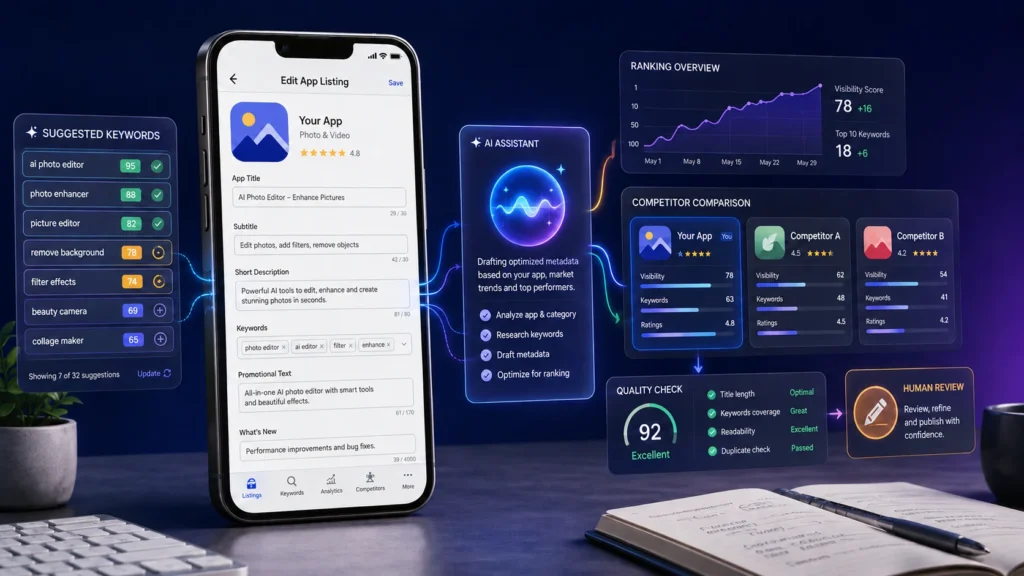
Writing effective app store metadata is time-consuming when done carefully — and it needs to be. A title, subtitle, and description must balance search relevance, user appeal, store policy compliance, and the category’s competitive context. Teams that skip any of those dimensions tend to publish metadata that either fails to rank or fails to convert the users it does reach. AI-assisted drafting tools are now part of how some teams approach this challenge, but their value depends entirely on how they are integrated into a broader workflow.
Metadata Context
App metadata serves two audiences at once: the store’s search algorithm and the user reading the listing. Ranking well for relevant queries matters only if the app description then gives users a reason to install. This dual purpose makes metadata writing harder than it might appear. Keyword-first copy often reads mechanically. Conversion-first copy sometimes ignores what users are actually searching for. The most effective metadata threads both — and does it within the character limits and formatting rules each store enforces.
Why App Text Needs Both Data and Creativity
Strong metadata usually starts with data. What are users searching for in this category? What language do competitor listings use? What pain points does the app solve, and how are users describing those problems in reviews? What keywords are currently driving rankings for similar apps? These questions have data-driven answers, and working from that foundation produces copy that is grounded in actual search behavior rather than assumptions. But the writing itself still requires creative judgment — decisions about tone, structure, hook strength, and how to frame product benefits in ways that feel clear rather than clinical.
How AI Can Support Drafting
AI text tools can accelerate the early stages of metadata drafting by generating variations quickly, proposing alternative phrasings for the same feature, or producing a working first draft that a human editor can then shape. The time saved in generating raw material can be redirected toward quality review, competitive comparison, and testing strategy. What AI does not replace is the judgment required to evaluate those drafts against keyword data, check them for policy compliance, and decide what a specific audience will respond to. Teams that use AI drafting as a starting point — rather than a final output — tend to get more out of it.
How ASOMobile Connects Text Ideas With ASO Data
ASOMobile is an app store optimization service that combines keyword research, rank monitoring, competitor analysis, market data, and text preparation tools in one interface. When drafting metadata, teams can cross-reference keyword search volumes, check how competitors have structured their own listings, and identify which terms are worth including based on current ranking data. This means that metadata ideas — whether generated by an AI tool, pulled from a competitor comparison, or developed internally — can be validated against actual search behavior before any text goes live.
Quality Checks Before Publishing
No metadata should go to the store without a structured review. Does the text include the target keywords naturally? Does it stay within character limits for each field? Does it comply with the store’s current content policies? Does it accurately represent the app’s actual functionality? Does it read clearly to a user who has never heard of the product? These questions apply regardless of how the metadata was initially drafted. Teams that treat quality review as optional — whether they used AI assistance or not — tend to encounter preventable problems with indexation, policy flags, or poor conversion rates after launch.
Soft CTA
App teams looking to streamline how they prepare and review metadata can explore the free tools available at ASOMobile and assess which fit their current drafting and review process.
FAQ
What is AI metadata drafting for apps?
AI metadata drafting refers to using AI text generation tools to produce initial versions of app store copy — titles, subtitles, and descriptions — that human editors then review, refine, and validate against keyword data and store guidelines before publishing.
How can ASOMobile support app metadata ideas?
ASOMobile provides keyword research, competitor listing analysis, and text preparation tools that help teams evaluate metadata drafts against real search data. This allows teams to check whether proposed copy targets relevant queries and aligns with competitive benchmarks.
Can an app description generator improve ASO workflows?
It can accelerate drafting and increase the number of variants a team considers. Whether it improves outcomes depends on how thoroughly the generated text is reviewed, validated against keyword data, and edited for clarity and compliance before publishing.
Why should teams validate generated metadata?
Because AI-generated text does not automatically account for keyword relevance, character limits, store policy requirements, or the specific language preferences of the app’s target audience. Validation against these criteria is what turns a draft into publishable copy.
What makes app metadata effective?
Effective metadata ranks for queries users actually search, presents the app’s value clearly enough to drive installs, complies with store policies, and is localized appropriately for each target market. Achieving all of these together requires both data and editorial judgment.